The Space Between: What Makes Ketamine-Assisted Psychotherapy Different from Traditional Talk Therapy

There is a rhythm to talk therapy. A cadence we come to know.
We name patterns. Explore narratives. Learn tools.
And for many, this is enough. It’s meaningful. Transformative. Steady.
But sometimes, insight alone isn’t what’s missing.
Sometimes, the body still holds the story.
Sometimes, healing asks us to speak in a different language.
This is where Ketamine-Assisted Psychotherapy (KAP) offers something uniquely powerful.
A Different Kind of Depth
Traditional talk therapy works primarily through the conscious mind—exploring thoughts, behaviors, and emotions with reflection, insight, and relational attunement.
KAP brings in a new dimension:
A shift in consciousness.
A pause in the overactive inner critic.
A softening of defenses that are too deeply woven to dismantle through words alone.
Ketamine quiets the “default mode network” in the brain—the part responsible for self-referencing thoughts and habitual mental patterns. When this network is dialed down, clients often experience:
A break from depressive or anxious looping thoughts
Increased access to repressed or unconscious material
Profound emotional release or spiritual insight
A sense of connectedness beyond the usual self-concept
In this altered state, people often say, “I finally understood it, not just with my mind—but with my whole being.”
Therapy That Moves Through the Body, Not Just the Brain
Traditional therapy helps us think differently.
KAP helps us feel differently—and then work with what emerges.
With the guidance of a skilled therapist, clients are supported in accessing somatic intelligence, unresolved trauma, or deep grief that lives in the body. This allows the therapeutic process to become more experiential than purely cognitive.
And when we integrate that experience afterward, we create lasting neural pathways that support healing beyond the session.
Not a Shortcut—A Different Path
KAP isn’t about speeding things up. It’s not about bypassing your story, your symptoms, or your process.
It’s about stepping out of the loop long enough to see a new way through.
It’s about touching a version of yourself that remembers wholeness—and then gently walking that version back into your daily life.
For some, KAP reignites a sense of hope after years of stagnation.
For others, it’s the first time therapy has truly landed.
A Side-by-Side Comparison
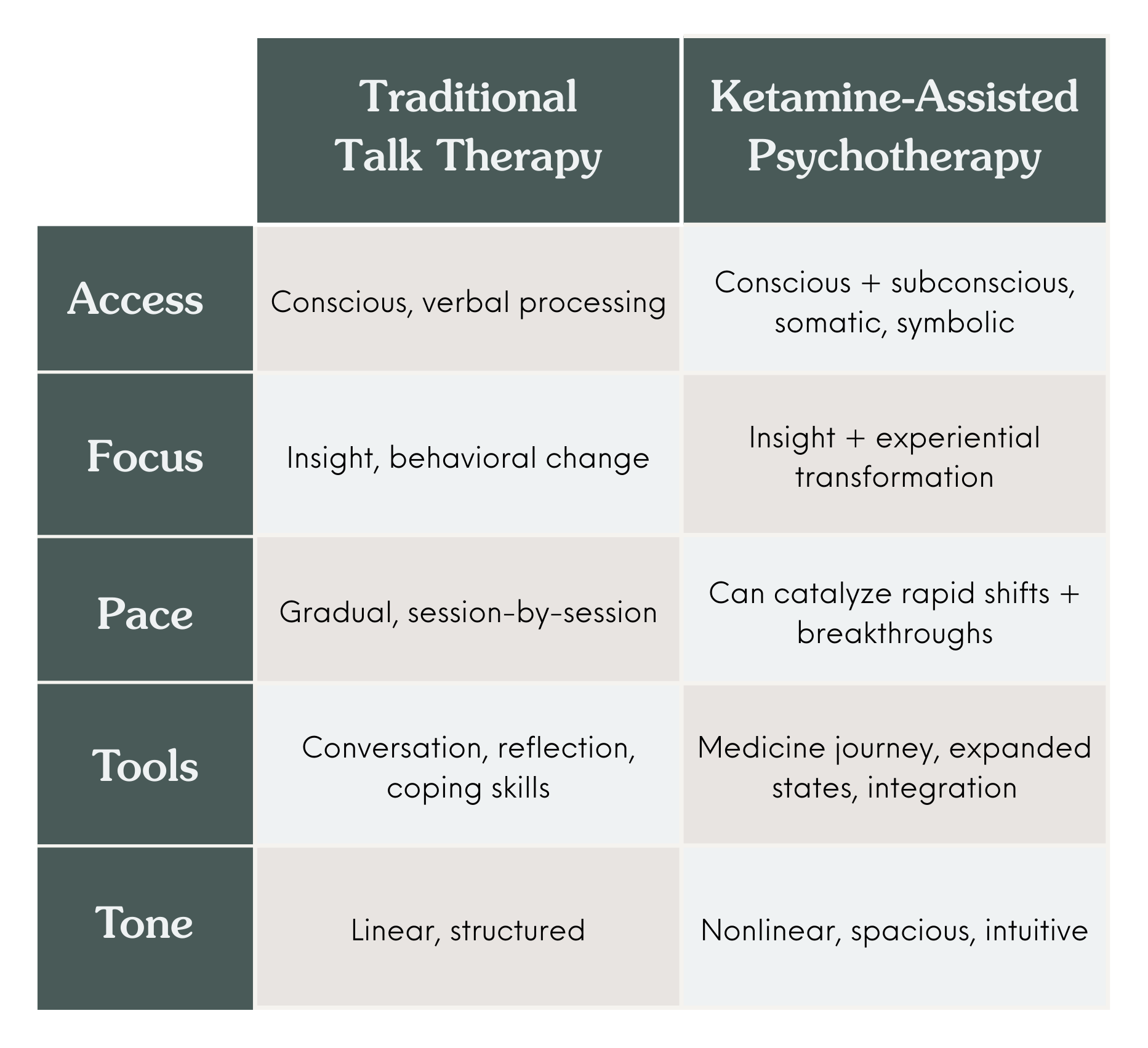
An Invitation to Go Deeper
KAP isn’t a replacement for traditional therapy—it’s a companion. A deepening. A bridge between insight and embodiment.
Whether you’re feeling stuck, burned out, or just ready for something new, this approach offers a sacred pause from the noise of the mind—and an opening into something more spacious, more honest, more alive.
Sometimes healing doesn’t sound like language.
Sometimes, it sounds like stillness.
Like a heart beating slower.
Like a memory surfacing softly.
Like a breath you didn’t know you were holding, finally let go.
Curious if KAP is right for you? Let’s talk.
You don’t have to navigate it alone.
✨ Want to keep exploring?
This blog is part of a 10-part series on healing through Ketamine-Assisted Psychotherapy. I’ve created a free companion workbook to help you pause, reflect, and make this journey your own.